Drafting Tools and Supplies for Beginners
A beginner's drafting tools list: the hand drafting tools and supplies real drafters use, what each one does, and how to build a starter kit.
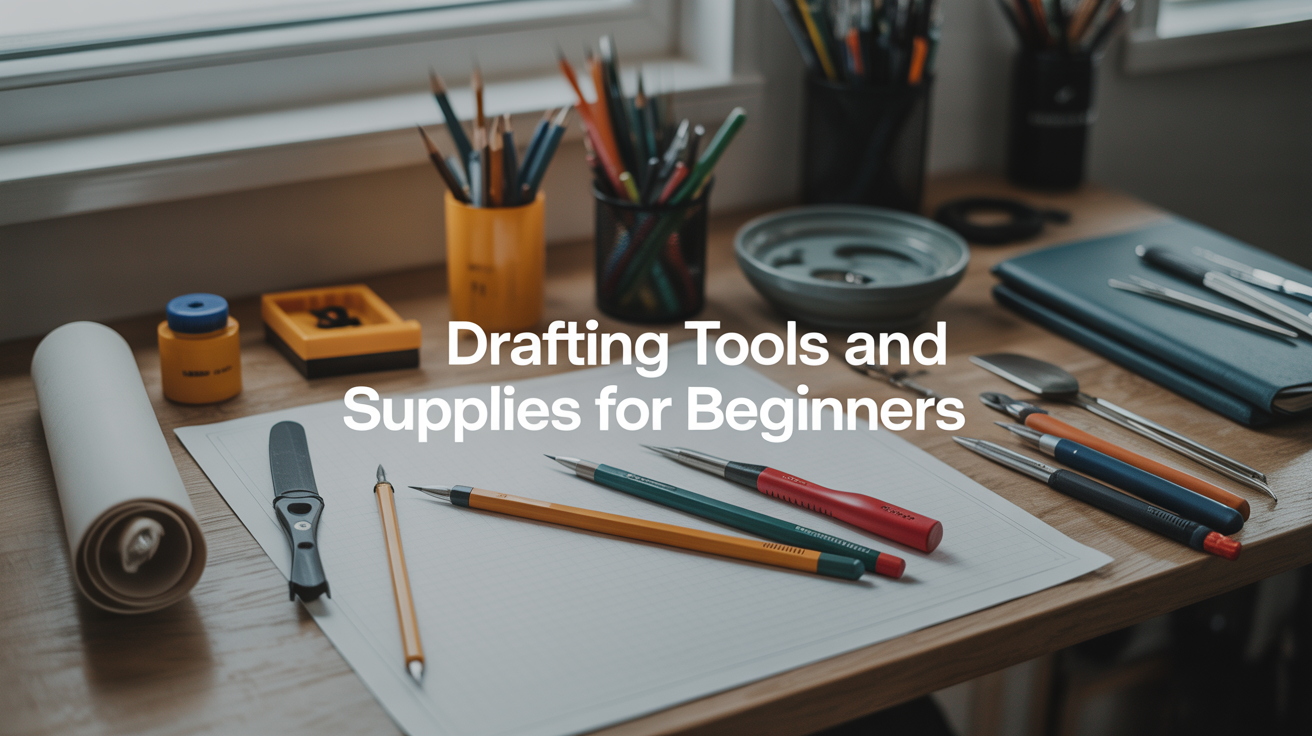
If you want a straight answer to "what tools do drafters use," here it is: a drafting board or flat table, a T-square or parallel straightedge, a couple of triangles, an architect's scale, a compass, a set of drafting pencils, an eraser shield, and some way to keep paper from sliding around. That is the core drafting tools list. Everything else on the market is a variation or an upgrade on those basics.
This guide walks through what each tool actually does, how the pieces work together, and which ones are worth buying first if you are just starting to learn to read or draw plans by hand.
Why Build a Hand Drafting Kit at All
Most professional drafting today happens on a computer, so it is fair to ask why a beginner should bother with pencils and triangles. Two reasons. First, hand drafting tools teach you the logic behind every drawing convention on screen: why lines have different weights, why scale matters, why a plan is drawn the way it is. Second, a basic hand kit is cheap and portable. You can sketch a room layout on a job site or at a kitchen table without opening a laptop.
If you are still fuzzy on what a "scale" even means or why line weight changes from one part of a drawing to another, it helps to read through how scale and line weights work before you shop for tools, since several items on this list exist specifically to draw at scale and produce consistent line weights.
The Core Drafting Supplies List
Here is a practical breakdown of the tools that make up a beginner drafting kit, what each one is for, and roughly how much you need to spend to get a usable version.
| Tool | What it does | Typical cost tier |
|---|---|---|
| Drafting board or flat table | Provides a smooth, stable surface to draw on | Inexpensive to moderate |
| T-square or parallel straightedge | Draws horizontal lines and anchors your triangles | Inexpensive |
| 30-60-90 and 45-45-90 triangles | Draw vertical and angled lines off the straightedge | Inexpensive |
| Architect's scale | Measures and draws at a fixed ratio, like 1/4 inch to 1 foot | Inexpensive |
| Compass | Draws circles and arcs, useful for radiuses and fixtures | Inexpensive |
| Drafting pencils or lead holder | Controls line darkness and width | Inexpensive |
| Eraser and eraser shield | Cleans up mistakes without smudging nearby lines | Inexpensive |
| Drafting tape or dots | Holds paper flat without tearing it on removal | Inexpensive |
| Circle template | Speeds up drawing repeated small circles, like fixtures or bolts | Inexpensive |
| French curve | Draws smooth curves that a compass cannot | Inexpensive |
You do not need every item at once. A board, a straightedge, one triangle, a scale, a pencil, and tape will get you through most beginner exercises. Add the rest as you take on projects that call for them.
Measuring and Layout Tools, Explained
The tools in this group are what let you get dimensions right, which matters as much as drawing neat lines.
The Architect's Scale
An architect's scale is not a ruler. A ruler measures actual distance. A scale lets you draw a shrunk version of something large, like a house, while keeping every measurement proportional. Most scales have several sets of marks along their edges, each one set up for a different ratio, so you can pick the scale a drawing is set at and read real-world feet directly off the edge. When you are reading someone else's plan rather than drawing your own, the same tool works in reverse: lay it against a wall on the drawing and read the actual length straight off the marks.
T-Squares and Parallel Straightedges
A T-square rides along the edge of your drafting board to give you a true horizontal line every time. A parallel straightedge does the same job but glides on a track built into the board, which keeps it from shifting the way a loose T-square can. Either one becomes the base you rest your triangles on, so accuracy here carries through every line you draw afterward.
Triangles
Triangles sit on top of your straightedge to give you vertical and angled lines. A 45-45-90 triangle gives you verticals and 45-degree angles. A 30-60-90 triangle adds 30- and 60-degree angles. Between the two, you can construct most of the angles that show up in a typical floor plan or elevation.
Drawing and Marking Supplies
Once your layout tools are set, the drawing supplies determine how the finished sheet looks and reads.
Drafting pencils come in a range of hardness grades, marked with a letter and number like 2H or HB. Harder leads (H grades) make lighter, crisper lines good for construction guidelines you plan to erase later. Softer leads (B grades) make darker lines good for final linework and labels. Many drafters keep two or three grades on hand rather than one.
An eraser shield is a thin metal or plastic card with cutout shapes. You lay it over the area you want to erase and rub through the cutout, which protects the lines around it. It sounds minor until you have accidentally smudged an entire corner of a drawing trying to fix one small mistake.
Drafting tape and dots hold your paper to the board without tearing the sheet when you peel it off later, which ordinary tape will often do. A circle template speeds up repeated small circles, like door swings, plumbing fixtures, or bolt patterns, without resetting a compass each time. A french curve fills in smooth, irregular curves a compass cannot draw on its own, useful for things like curved stair rails or organic site contours.
Reading Plans With the Same Tools
A drafting tools list is not only for people who plan to draw. If your goal is learning to read plans someone else drew, an architect's scale and a triangle are still worth owning. The scale lets you check real dimensions on a printed plan instead of guessing from the drawn size. A triangle laid against a printed line helps you confirm whether a wall is truly straight or where an offset happens, which is handy when a drawing has been photocopied or scanned a few times and the lines have softened.
If you are new to the whole idea of drafting as a discipline, not just the toolbox, it is worth stepping back and reading what drafting actually involves for a beginner first. It covers the conventions and vocabulary that make sense of why these specific tools exist in the first place.
Hand Drafting vs. CAD: Do You Need Both?
Nearly all professional drawings today are produced in CAD software rather than by hand, and if your goal is to eventually design your own floor plan rather than just read one, it is worth trying a beginner-friendly digital tool alongside your hand kit. See our roundup of free floor plan software options once you are comfortable with the fundamentals.
That said, learning the hand tools first is not wasted effort even if you plan to move to software quickly. Every CAD program still organizes drawings around scale, line weight, and layers of information the same way a hand-drafted sheet does. A beginner who has drawn a wall with a T-square and triangle understands why a CAD program asks for a scale before printing, or why line weights matter when a drawing is reduced. The hand tools are cheap enough that trying them first costs you very little, and the understanding carries over directly.
Frequently Asked Questions
What is the single most important tool on a beginner drafting supplies list?
If you can only buy one thing, get an architect's scale. It is the tool most directly tied to reading and drawing at the correct proportions, and it is useful whether you are drafting by hand, checking a printed plan, or double-checking a CAD drawing against a paper copy.
Can I learn to draft without a drafting board?
Yes, for basic sketching. A smooth table and a portable parallel straightedge or a large cutting mat can substitute early on. A dedicated board becomes more useful once you are doing repeated, precise work, since it holds paper flat and gives your straightedge a true edge to ride against.
Do I need metric and imperial scales?
It depends on where you live and what plans you are working from. Most of North America drafts in feet and inches, while much of the rest of the world uses metric. Check which system the plans in your region typically use before you buy a scale, since some scales combine both and others are dedicated to one system.
How much should a beginner expect to spend on hand drafting tools?
A basic starter kit, covering a board, a straightedge, one triangle, a scale, a pencil, an eraser, and tape, is one of the least expensive ways to get into drafting. You can always add a compass, a circle template, or a french curve later once you know which extras your projects actually call for.