Understanding Building Elevations
Learn what an elevation drawing is, how to read exterior elevations, and what all those dimensions and symbols actually mean for your project.
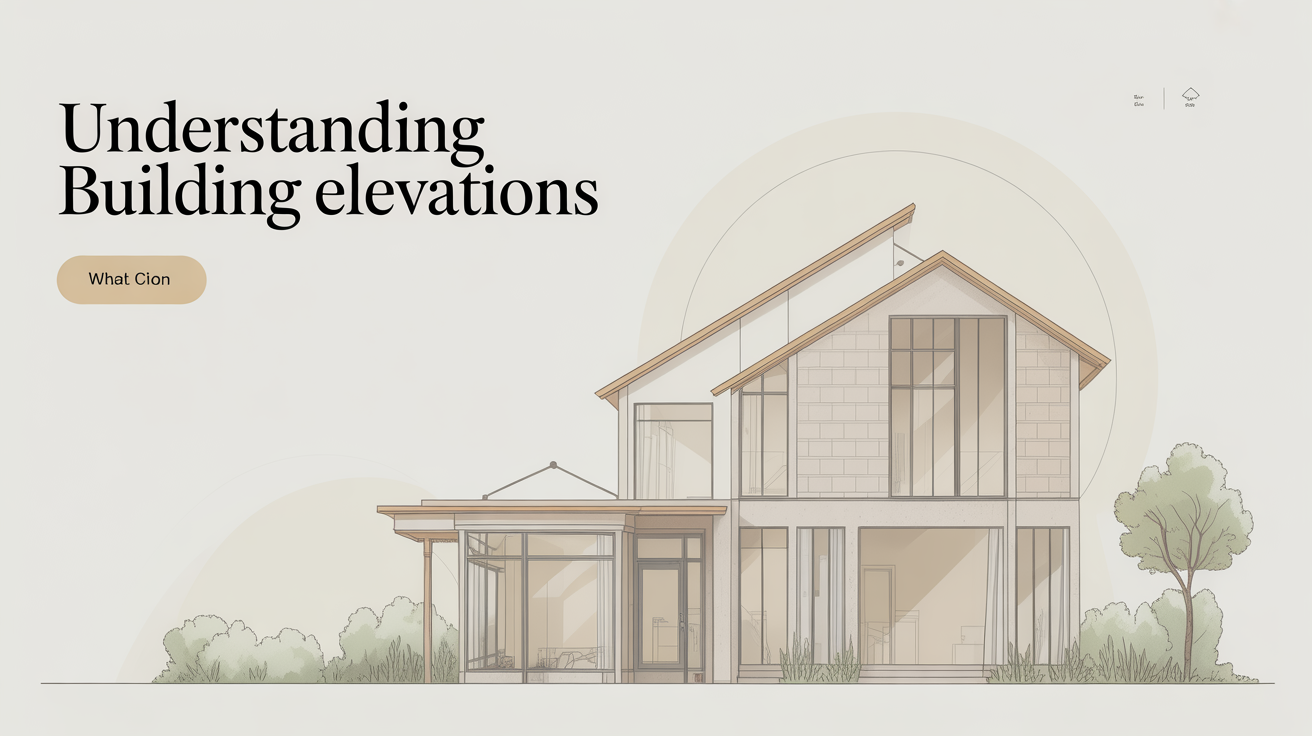
If you've ever flipped through a set of house plans and come across a sheet that shows the outside of the building from the front, back, and sides, you've found the elevation drawings. They're one of the most useful sheets in any plan set, yet they often get ignored in favor of the floor plan. This guide explains what elevation drawings show, how to read them, and why they matter, even if you've never looked at architectural plans before.
What Is an Elevation Drawing?
A building elevation is a flat, straight-on view of the outside of a structure from one direction. Think of it like a photograph taken from eye level, far enough away that nothing is distorted, with all the depth removed. You're looking at the face of the building, not into it.
Architects typically draw four exterior elevations for a house: front, rear, left side, and right side. They're usually labeled by compass direction (North Elevation, South Elevation, etc.) or by position relative to the building (Front Elevation, Rear Elevation). Either labeling system is fine; the title block on each sheet or a small reference diagram will tell you which face you're looking at.
The purpose of an elevation drawing is to show:
- The finished height of the building and its various parts
- The location, size, and type of windows and doors on each face
- Roof pitch and the shapes of gable ends, dormers, or other roof features
- Exterior cladding materials (siding, brick, stucco, etc.)
- Horizontal and vertical dimensions that can't be read from a floor plan alone
A floor plan tells you where things are in the horizontal plane. An elevation drawing adds the vertical dimension. Together, they give you a much more complete picture of what's being built. You can read more about how these sheets fit into the full package in What's in a Set of Construction Drawings?.
The Key Elements on an Elevation Drawing
Datum Lines and Finished Floor Heights
Near the bottom of most elevation drawings, you'll see one or more horizontal dashed or solid reference lines labeled with abbreviations like F.F.L. (Finished Floor Level), F.G.L. (Finished Grade Level), or simply F.F. These are datum lines, fixed horizontal benchmarks from which vertical heights are measured.
The finished floor line is important because it's how you know where the floor sits relative to the ground outside. If a house has a crawlspace, the floor may be 2 ft (about 600 mm) above grade. If it's slab-on-grade, the floor will sit just a few inches (around 50-150 mm) above the exterior ground. That difference has real consequences for entry steps, drainage, and accessibility.
Roof Pitch Indicators
A small triangle drawn on or beside a sloped roof line is a pitch indicator. It shows the slope of the roof as a ratio of rise to run. In the United States, this is typically written as something like 6:12 or 6/12, meaning the roof rises 6 inches for every 12 inches of horizontal run. In metric-system countries, slope is often expressed as a ratio like 1:2 or as a percentage.
A 4:12 pitch looks fairly shallow from outside. A 12:12 pitch is steep, roughly 45 degrees. The steeper the pitch, the more dramatic the roofline looks on the elevation, and the more it typically costs to build and roof.
Window and Door Openings
Each window and door on a face of the building appears on its corresponding elevation. You'll see the overall opening height, any sill or head height dimensions, and often a notation indicating the window type (casement, double-hung, fixed, etc.). Window and door sizes are usually also called out by a number or letter tag that matches a separate schedule elsewhere in the plan set.
Heights matter here in ways the floor plan can't show you. A standard interior door is 6 ft 8 in tall (about 2030 mm) from finish floor to top of frame. An entry door might be 8 ft (2440 mm). The elevation is where you can actually see whether that tall entry door will look balanced with the rest of the facade.
Material Callouts and Hatching
Different materials are often shown with different hatch patterns or symbols on the elevation. Brick courses might be shown with a grid pattern. Board-and-batten siding might appear as vertical lines. Stucco might be shown as a plain surface with a texture callout. These callouts are accompanied by a note pointing to the material, often referencing a specification number for the full material description.
Don't assume a hatch pattern in one drawing set means the same thing it does in another. Always check the legend or notes on the sheet.
How to Read Dimensions on an Elevation
Elevation drawings carry two types of dimensions: overall heights and specific feature heights.
Overall building height is typically measured from finished grade to the peak of the roof or the top of the parapet (on a flat-roofed building). Local zoning codes often limit building height, so this dimension gets scrutinized during permit review. Check with your local building department to confirm which measurement point your jurisdiction uses.
Feature heights include things like:
- Window head height (the top of the window frame above the floor)
- Window sill height (bottom of the frame above the floor)
- Ceiling height (shown as a dashed line and noted on the elevation)
- Plate height (where the wall framing ends and the roof structure begins)
A common convention is to give window head and sill heights as dimensions measured from the finished floor line. So a notation might read "7'-0" to TOP OF WINDOW HEAD" measured upward from the F.F.L. line. In metric drawings, that same detail might read "2100 mm to T.O.W.H."
If you're comparing elevation heights to floor plan room dimensions, remember the floor plan works in horizontal feet and inches while the elevation works vertically. They're complementary, not redundant. For a deeper look at how site-related heights interact with the building, see How to Read a Site Plan.
Interior Elevations vs. Exterior Elevations
A quick word on terminology, because "elevation" can refer to two different things in a plan set.
Exterior elevations are the four (or more) views of the outside of the building described above.
Interior elevations are detail drawings that show one wall inside a room, looking straight at it. They're common in kitchens, bathrooms, and any space with built-in cabinetry, tile patterns, or features that need to be precisely positioned. An interior elevation of a kitchen might show the exact height of upper cabinets, the tile backsplash border, and where outlets and switches land relative to the countertop.
Both types of drawings use the same basic conventions. The key difference is context. If you're looking at a sheet labeled "Kitchen Elevations A, B, C, D," you're looking at four walls inside the kitchen, not four sides of the building.
What Elevation Drawings Won't Tell You
An elevation is a flat projection. It shows you the face of the building but strips out all depth. A bay window, a covered porch, or a deep overhang can look very different in real life than the two-dimensional elevation suggests. Section drawings, which cut through the building vertically to show the relationship between interior and exterior, fill in some of that missing information. For that, see How to Read a Section Drawing.
Elevations also don't show the ground conditions around the building in detail. Retaining walls, grade changes, and drainage slopes belong on the site plan. If you're trying to figure out how a hillside site affects the apparent height of the building on each side, you need both drawings together.
Finally, elevations don't show structural framing, insulation, or hidden connections. Those live on structural drawings, wall sections, and detail sheets within the full plan set.
A Quick Reference: What to Look for on Each Elevation
| Element | Where to Find It | What It Tells You |
|---|---|---|
| Datum line (F.F.L. / F.G.L.) | Bottom of the sheet | Reference heights for all vertical dimensions |
| Roof pitch triangle | On sloped roof lines | Steepness of the roof (e.g., 6:12) |
| Window/door tags | Beside each opening | Cross-references to the window/door schedule |
| Overall height dimension | Vertical dimension string | Building height for zoning compliance |
| Plate height | Horizontal dashed line with note | Where walls end and roof framing begins |
| Material callouts | Leader lines with text notes | Cladding types and finish materials |
| Ceiling height | Dashed line inside the wall outline | Interior ceiling level visible on exterior |
Frequently Asked Questions
How many elevation drawings should a set of plans include?
Most residential plan sets include four exterior elevations, one for each face of the building. If a project has a complex footprint with re-entrant corners, there may be additional partial elevations to capture areas that would be obscured in a straight-on view. Commercial projects often include more. Interior elevations are separate sheets and are counted in addition to the exterior set.
What does the number next to a roof line mean?
That's the roof pitch notation. In the US, you'll typically see it written as a fraction or ratio inside a small right-triangle symbol, such as 4/12 or 8:12. The top number is the rise in inches, the bottom number is always 12 (the standard run). So 8:12 means the roof rises 8 inches for every 12 inches of horizontal distance. Countries using metric systems often express pitch as a percentage or a 1:X ratio instead.
Can I use the elevation drawing to figure out window sizes?
Partly. The elevation shows the rough opening size and the window head and sill heights. But for exact glass sizes, frame dimensions, and manufacturer specs, you'll need to cross-reference the window schedule, which is a separate table within the plan set that lists each tagged window by type, dimensions, material, glazing, and often the manufacturer's model number.
Why do some elevations show dashed lines inside the wall?
Dashed lines on an elevation typically indicate hidden features, things that exist behind the wall plane you're looking at. A dashed horizontal line might show a floor level inside the building, a ceiling height, or a footing at the base of the wall below grade. They help you understand the internal geometry of the building without having to flip back to a separate drawing every time.
Do I need elevation drawings for a building permit?
In most jurisdictions, yes. Permit offices typically require at minimum the four exterior elevations along with the floor plans and a site plan. The elevations help reviewers verify that the building height complies with local zoning, that windows meet egress or light requirements, and that the exterior materials are appropriate for the zone. Requirements vary, so confirm the specific submittal checklist with your local building department before preparing a permit application, and have a licensed architect or engineer review the drawings before you submit.